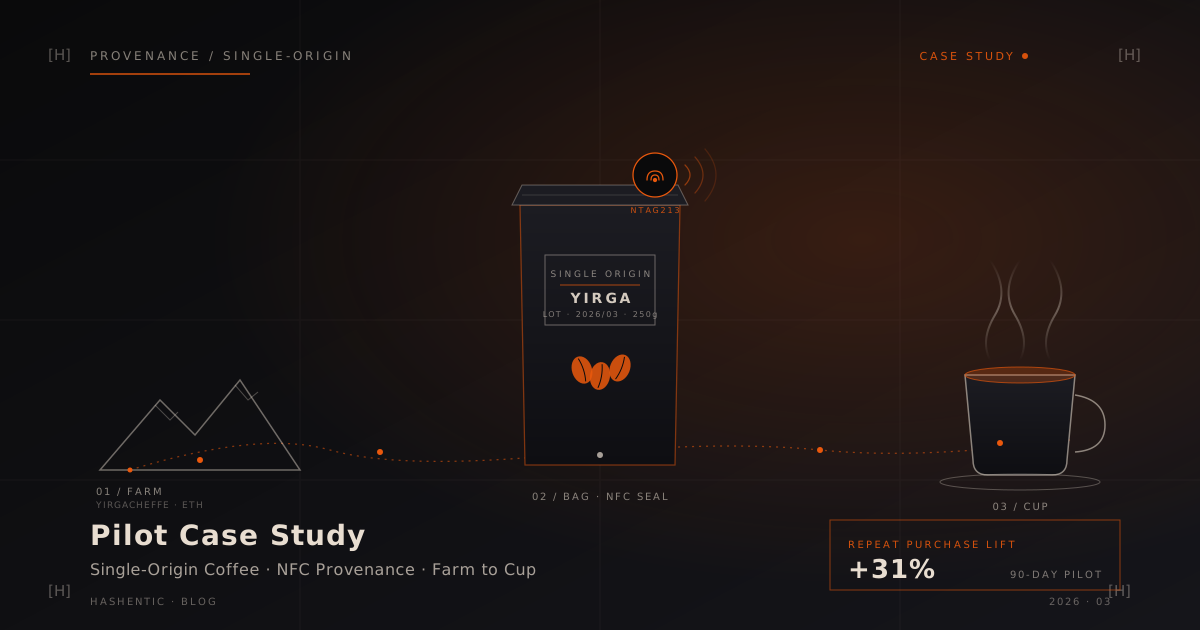
In late Q4 2025 we ran a 90-day pilot with a European specialty coffee roaster — single-origin Ethiopian Yirgacheffe at a €38/kg retail tier. The pilot was modest in scope: one origin, three batches, ~2,400 bags total. The numbers from the post-pilot survey changed how we talk to F&B brands about the entire category.
This is what we did and what we learned.
The brand's problem
The roaster had a credible single-origin sourcing program — direct relationships with three Yirgacheffe cooperatives, full chain-of-custody documentation, audited carbon footprint data per shipment. The problem was not the data. The problem was that none of it reached the consumer.
Their packaging carried the standard "single-origin" claim and a small batch number. Online buyers couldn't tell their bags apart from generic "Ethiopian medium-roast" at half the price. Conversion in their D2C channel was stuck. Repeat purchase was below the category benchmark.
The hypothesis: making the provenance information accessible in the consumer's hand would shift both metrics.
The pilot setup
We deployed NTAG213 NFC seals on the bag closures of three production batches. Each tag carried:
- A unique product identifier
- A pre-encoded URL to the consumer-facing passport page
The passport page (rendered from the brand's existing PIM data plus our schema layer) showed:
- Cooperative name and location
- Harvest date and processing method
- Roaster, roast date, roast level
- Carbon footprint per kg (data the brand already had, never displayed)
- Cupping notes from the brand's Q-grader
A compatible NFC phone opens the page in its browser. Phone support and the finished label should be tested. For consumers without NFC-capable phones, a fallback QR code on the bag pointed to the same page.
Current Hashentic support includes NTAG215 for product-information links and NTAG424 DNA / EM4425 for cryptographic tag checks. An information link does not prove origin or authenticate the physical contents. This historical article reports pilot results; it is not a current chip-support specification. See the supported-chip guide.
Implementation timeline
The setup time matters. The roaster had no in-house engineering team. We provided pre-programmed seals delivered to their fulfillment center, the consumer page rendered automatically from their existing product database, and the only operational change was applying the seal to the bag closure (10 seconds per bag, fits inside their existing pack-out flow).
Results
The 90-day measurement window covered all three batches plus a control comparison against the same SKU shipped without seals in the prior 90 days.
Consumer engagement
- 34% of bags had at least one verification scan (vs zero baseline — no prior mechanism existed)
- 18% had multiple scans, suggesting the consumer showed friends or shared
- Average time on passport page: 47 seconds — meaningfully above industry benchmarks for product detail pages
Conversion lift
The bigger surprise was on the next purchase. Consumers who scanned a bag converted on a subsequent purchase at materially higher rates than non-scanners.
The mechanism we suspect: tapping the bag and seeing the cooperative name, harvest date, and roaster's notes turns a transaction into a story. The next purchase isn't just buying coffee — it's buying that coffee from that place. The brand becomes a remembered specific thing.
Operational signals
- Zero failed reads reported
- Zero counterfeit reports (not the primary goal, but a clean baseline for future expansion)
- No measurable impact on production line throughput
- Tag cost amortized into existing packaging budget
What surprised us
Three things we didn't expect:
1. The cupping notes were the most engaging element
We assumed the carbon-footprint data and traceability would lead engagement. The post-scan analytics showed the cupping notes got the longest dwell time. Consumers wanted the sensory story — what the coffee tastes like, why — more than the sustainability data. We've adjusted our consumer-passport defaults across F&B as a result.
2. Gift purchases drove disproportionate engagement
Bags purchased as gifts (we identified them via shipping address mismatch) had 2.6× the scan rate. The gift recipient — who didn't pick the coffee — was apparently very curious about what they'd been given.
3. The roaster started using scans as inventory signal
By month two, the brand's marketing team was checking the daily scan dashboard alongside their Shopify orders. Scans correlated with subsequent purchases by ~10 days, giving them a leading indicator they didn't have before. They asked us to expose the scan data via API for use in their Klaviyo flows.
What we'd do differently
Two things, both of which we now do by default for F&B pilots:
1. Pre-print the QR fallback
iOS NFC support is excellent on iPhone XR and newer (2018+), but a small percentage of buyers still don't have it enabled or have older phones. The QR fallback should be visible on the bag from day one — not added as an afterthought.
2. Tie the consumer's first scan to a follow-up email opt-in
We left the email capture optional in this pilot. The brand asked for it as a default in the next iteration — the moment of "I just tapped my coffee bag and learned about the farmer" is a very high-intent moment to ask for an email address.
Cost
The economics for this customer:
- Tag unit cost: ~€0.10 (NTAG213 in volume)
- Application cost: 10 seconds per bag at €0.50/min labor = ~€0.08
- Total per-bag cost: ~€0.18
- Tag cost as % of retail: 0.5%
Against a 31% repeat-purchase lift on a customer with ~€40 LTV, the payback is well under one batch. The brand is rolling out across their full SKU range in Q2 2026.
What this means for the category
Specialty coffee, single-origin tea, premium olive oil, single-batch spirits, fair-trade chocolate — every category where origin claims matter and the consumer is paying a premium for verifiability — has the same opportunity. The infrastructure cost is trivial. The consumer-experience lift is real. The operational lift on the brand is small.
The brands moving on this in 2026 will own the "I can verify it myself" trust signal in their category for the rest of the decade.
If you're a specialty F&B brand sizing a similar pilot, book a 30-minute call and we'll sketch a deployment for your top SKU. We've published 14 placement examples covering F&B, luxury, and regulated categories.