[H]Hashentic
Request Demo

EU Battery Regulation 2026: What Manufacturers Must Deliver

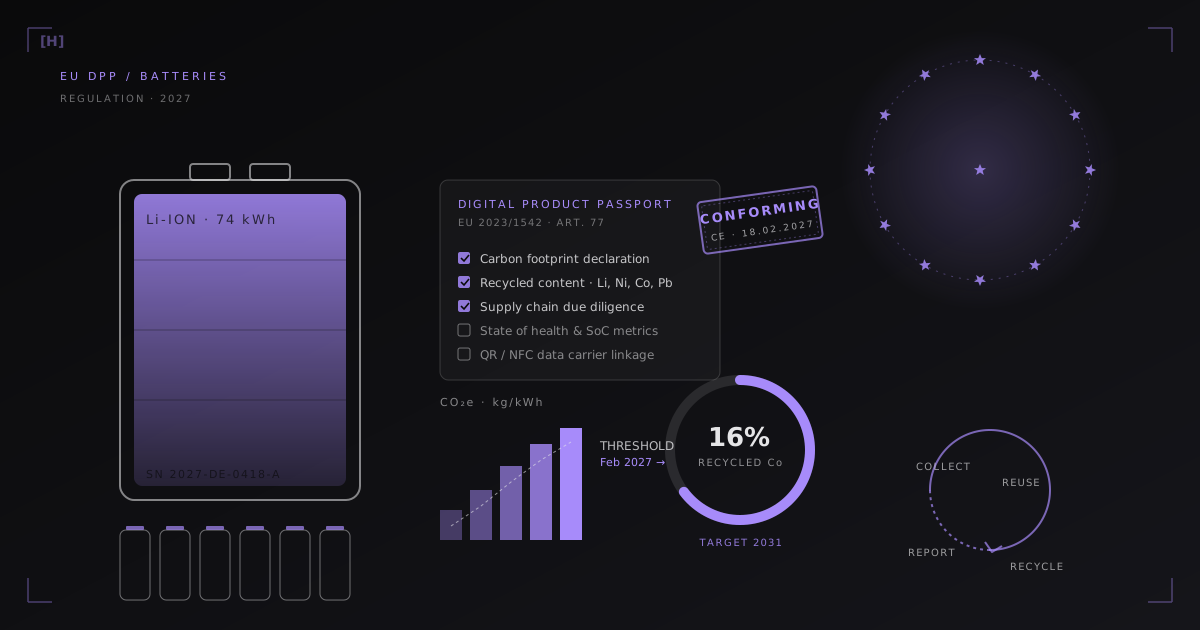
EU 2023/1542 mandates Battery Passports from February 2027 with phased data requirements starting 2026. Here is exactly what manufacturers must collect, store, and expose.

EU Battery Regulation 2026: What Manufacturers Must Deliver

The EU Battery Regulation (EU) 2023/1542 is the first ESPR-aligned passport regulation to bite. It enters core enforcement in February 2027, but the data collection requirements β€” the part that takes 12+ months to operationalize β€” start kicking in through 2026.

Battery manufacturers, EV OEMs, and industrial battery integrators that don't have a passport infrastructure plan in place by Q1 2026 will not make the deadline. This article is the operator's checklist.

Scope: who is affected

The regulation covers all batteries placed on the EU market, but the Battery Passport requirement specifically targets:

  • EV batteries (battery electric vehicles, plug-in hybrids)
  • LMT batteries (light means of transport β€” e-bikes, e-scooters)
  • Industrial batteries above 2 kWh capacity
  • Stationary energy storage systems

Portable consumer batteries (laptops, phones) are scoped under a different lighter-touch regime.

If you sell any of the four categories above into the EU β€” whether as a battery manufacturer, a vehicle OEM, or an integrator β€” you must issue a passport per battery before sale.

The timeline

Aug 2024Regulation in force
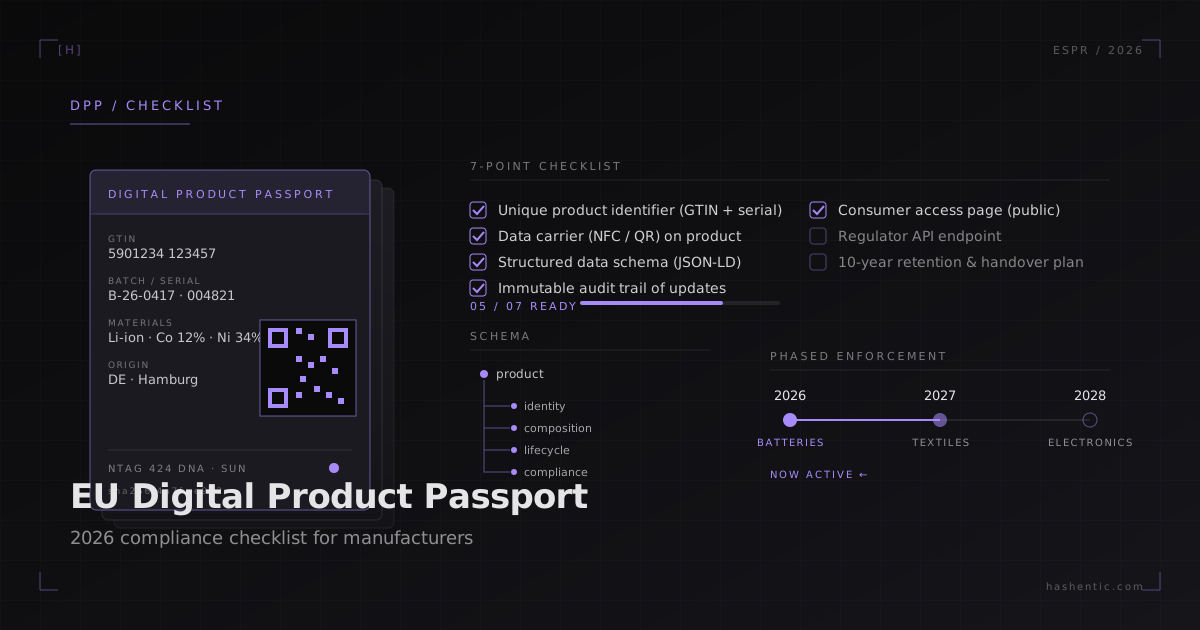
2026Data collection mandatory
Feb 2027Battery Passport mandatory
2028+Performance & durability data live

Critical detail: data does not start being collected on the deadline date. Several mandatory fields require historical data going back 12+ months β€” carbon footprint by life-cycle stage, recycled content percentages, supply-chain due diligence reports. If you start collecting in January 2027, you're already non-compliant.

What the passport must contain

The full schema is published in the Commission's delegated acts, but the operational categories are:

1. Identity and origin

  • Unique product identifier (GS1-compatible)
  • Manufacturer name, address, and registered identifier
  • Battery model and version
  • Date of manufacture and place of manufacture
  • Battery category and weight

2. Composition

  • Detailed materials breakdown (chemistry: NMC, LFP, NCA, etc.)
  • Critical raw materials present (cobalt, lithium, natural graphite, nickel β€” disclosed by mass)
  • Hazardous substances list
  • Recycled content percentages per material (cobalt, lithium, nickel, lead β€” separately)

3. Carbon footprint

  • Cradle-to-gate carbon footprint (kg COβ‚‚eq per kWh of total energy)
  • Carbon footprint declared per life-cycle stage (raw material acquisition, main production, distribution, end-of-life)
  • Carbon footprint performance class (A–G ranking introduced in delegated acts)

4. Supply chain due diligence

  • Conflict-minerals reporting per OECD framework
  • Supplier audits and certifications
  • Public summary of due diligence findings

5. Performance and durability

  • Rated capacity and minimum capacity
  • Cycle life and expected service life
  • State of health (SoH) accessible via diagnostics
  • Internal resistance evolution data

6. Repair, repurpose, recycling

  • Disassembly information
  • Repair and maintenance manual
  • Recycling information for second-life and end-of-life
  • Take-back partner identification

Items 4, 5, and 6 are the ones brands consistently underestimate. Supply-chain due diligence requires audit data from your tier-2 and tier-3 suppliers. Performance data requires diagnostic interfaces in shipping product. Repair documentation requires version-controlled publishing alongside every product variant.

Three operational decisions to make in Q1 2026

Decision 1: Identifier strategy

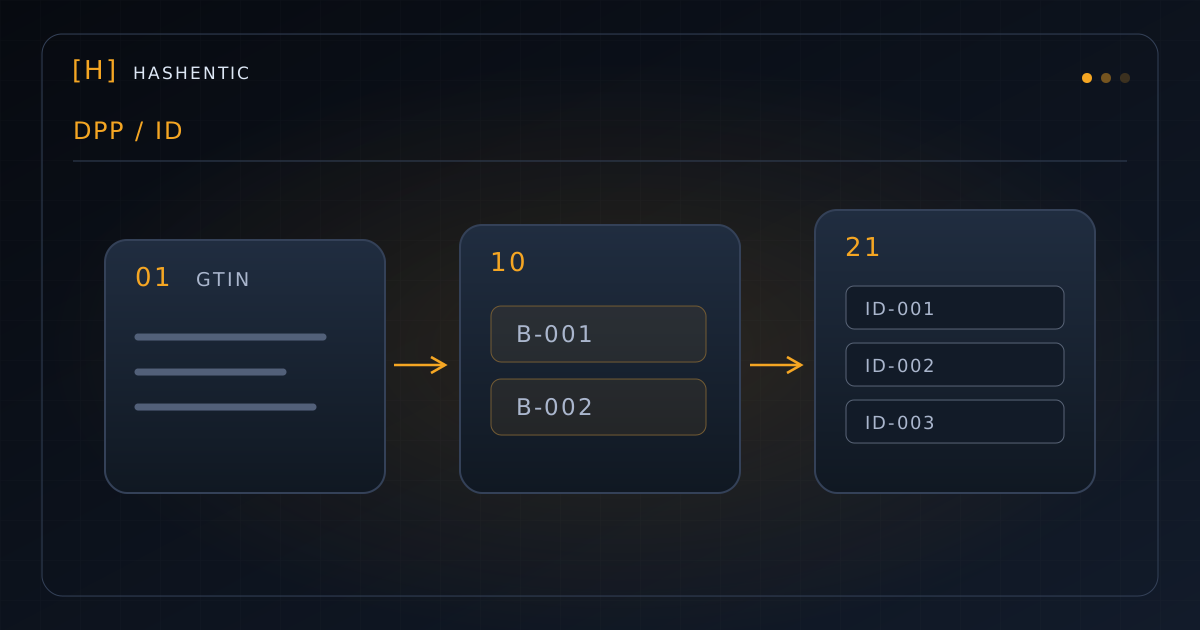
The passport must be machine-readable via QR, NFC, or RFID β€” physically affixed to the battery (or its housing). Most EV OEMs are landing on GS1-aligned identifiers + dual carrier (QR + NFC), with NFC for closed-loop diagnostic access and QR for consumer/regulator scan.

Decision 2: Data architecture

The passport is updated through the battery's life β€” performance degrades, ownership transfers, repairs are logged. Three data architectures are competing:

  • Centralized brand database β€” fastest to ship, but creates a vendor lock-in problem when the manufacturer goes out of business mid-warranty
  • Public blockchain β€” decentralized, but exposes commercially sensitive supply-chain data and incurs gas costs at scale
  • Private blockchain (hub model) β€” what we deploy at Hashentic via the Xordex engine; decentralized verifiability without supply-chain data leakage

The Battery Regulation explicitly contemplates decentralized identifier (DID) architectures. Most large OEMs are landing here.

Decision 3: Trust-anchor model

Regulators and recyclers must be able to verify a passport without trusting your servers. This requires either a third-party registry (the EU is building one) or cryptographic anchoring on a verifiable ledger. The regulation is technology-neutral on the mechanism, but the audit trail must be immutable and externally verifiable.

What it costs to be late

A single non-compliant battery shipment can be held at customs. For an EV manufacturer, that's a delivery delay measured in days β€” potentially per-shipment. For an industrial battery vendor, it's a contract-default trigger.

The real cost is reputational. The first headline of "battery brand X recalled because passport data was incomplete" will be a defining moment for that brand's compliance story.

What we recommend

For battery manufacturers and OEMs starting in Q1 2026:

  1. Pilot on one battery line first β€” pick the one with the cleanest supply-chain data
  2. Co-design with your tier-1 cell supplier β€” most material data lives there, not in your ERP
  3. Choose your identifier carrier early β€” production-line changes have the longest lead time
  4. Plan for the post-sale lifecycle β€” repair shops and recyclers need API access, not just QR scans
  5. Anchor the audit trail β€” pick your decentralized verification model now, not at deadline

The brands that ship one good Battery Passport in 2026 will have the operational learnings to scale across their portfolio in 2027. The ones that try to do everything at once miss the date.


Hashentic deploys EU Battery Passport infrastructure as part of the Enterprise tier β€” including GS1 + NFC carrier integration, Xordex private-chain anchoring, and the consumer-accessible passport view. Book a 30-minute battery-specific review to map your timeline against the regulation.


Ready to bring your products onto the trust layer?

Request a Demo← Back to Blog