NTAG213, NTAG215 and NTAG216 are the three members of NXP's NTAG21x family. They share the same radio interface, command set and security features; the main difference is how much data they hold. This guide compares the three chips using NXP's NTAG213/215/216 datasheet (Rev. 3.2), shows what fits on each one in practice, and explains where the whole family stops being enough.
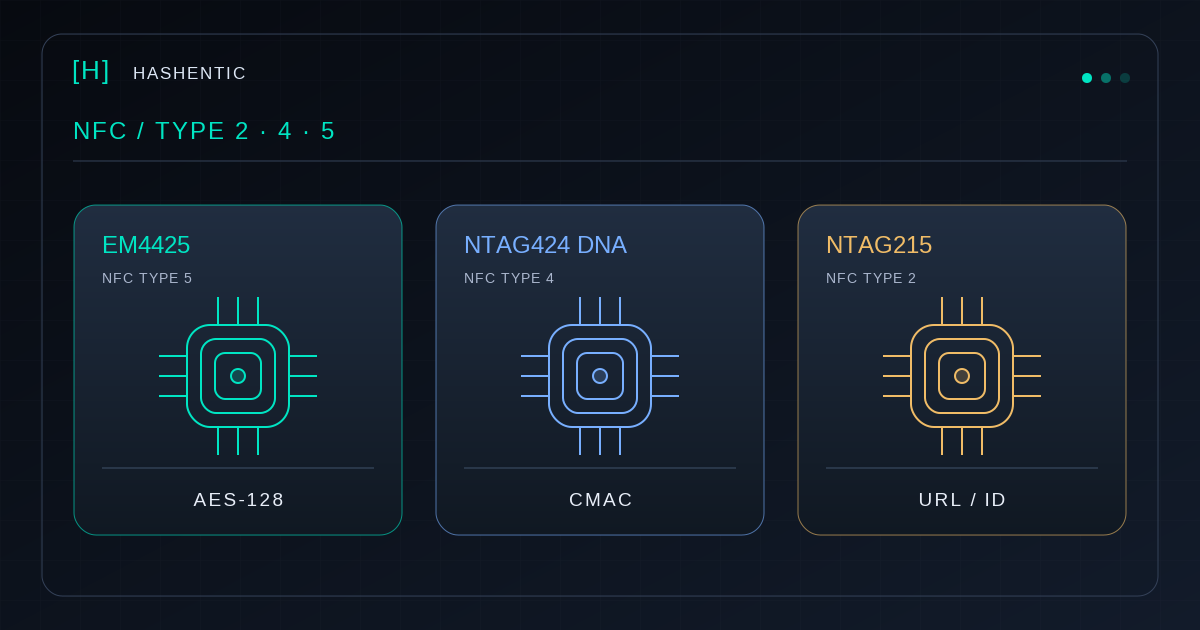
If you are deciding between a simple link tag and a secure authentication tag, read NTAG213 vs NTAG424 DNA afterwards. The chips Hashentic supports today are covered in the EM4425, NTAG424 DNA and NTAG215 guide.
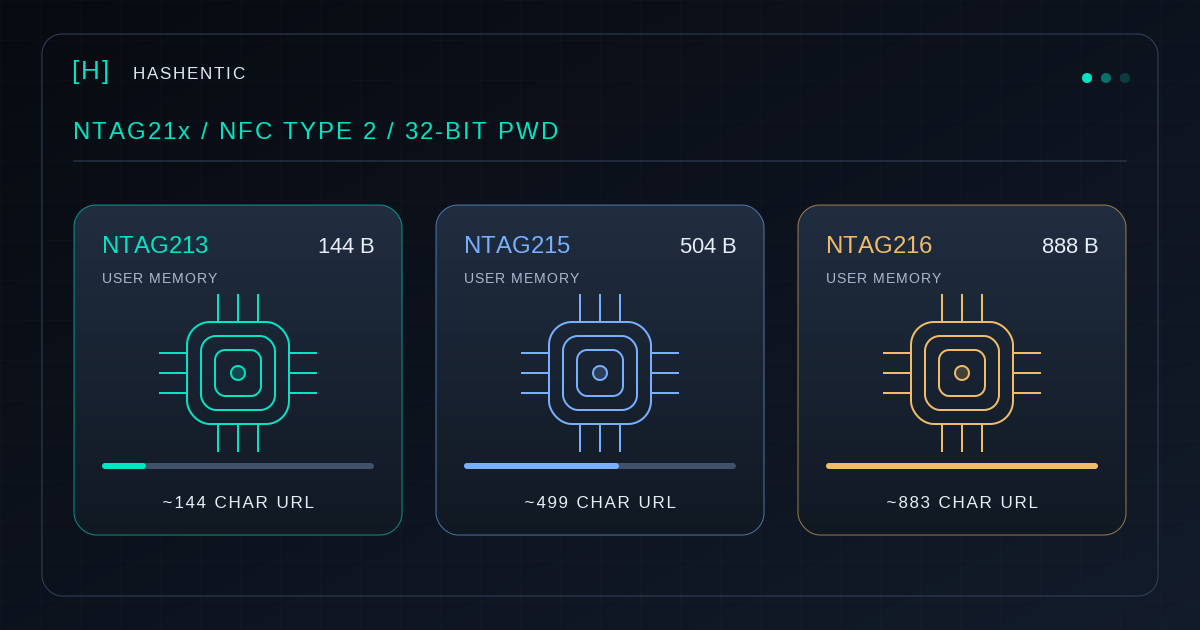
NTAG213 vs NTAG215 vs NTAG216 at a glance
All values below come from the NXP datasheet unless marked as a calculation.
| NTAG213 | NTAG215 | NTAG216 | |
|---|---|---|---|
| User memory | 144 bytes | 504 bytes | 888 bytes |
| Total EEPROM | 180 bytes (45 pages) | 540 bytes (135 pages) | 924 bytes (231 pages) |
Longest https:// URL (calculated, see below) | about 144 characters | about 499 characters | about 883 characters |
| NFC standard | NFC Forum Type 2, ISO/IEC 14443-A | same | same |
| UID | 7 bytes, factory programmed | same | same |
| Memory protection | 32-bit password, 16-bit PACK | same | same |
| Originality signature | 32-byte ECC (secp128r1) | same | same |
| NFC counter | 24-bit, with optional URL mirror | same | same |
| Operating distance | up to 100 mm, depending on antenna and field strength | same | same |
| Data retention / write endurance | 10 years / 100,000 cycles | same | same |
Swipe or scroll horizontally to compare columns.
The practical takeaway: choose by memory and by the size of the antenna you can fit, not by security. Moving from NTAG213 to NTAG216 gives you more bytes, not more protection.
How long can a URL be?
Most product tags hold a single URL in an NDEF message. The NDEF format adds a few bytes of overhead around the text, and the common https:// prefix is stored as a one-byte code. Working through the NFC Forum Type 2 layout (TLV header, record header, prefix code and terminator), the longest URL that fits is roughly:
- NTAG213: about 136 characters after
https://, so about 144 characters in total. - NTAG215: about 491 characters after
https://, so about 499 in total. - NTAG216: about 875 characters after
https://, so about 883 in total.
These are upper bounds that we calculated from the formats, not NXP figures. Real numbers are a little lower if the tag already carries lock or memory-control blocks, if you add a second record, or if your writing app uses a different record layout. Two more points matter in practice:
- Short URLs scan better. A short link reads faster and leaves room for later changes. Most product links fit comfortably on an NTAG213.
- Mirrors take space. The chip can insert its UID (14 hex characters) and its NFC counter (6 hex characters) into the URL each time it is read. Reserve those characters if you plan to use the mirrors.
The extra memory of NTAG215 and NTAG216 is useful for vCards, Wi-Fi credentials, several records on one tag, or long URLs with parameters.
Password protection: what the 32-bit password does
Each NTAG21x chip can protect a configurable part of its memory with a 32-bit password (PWD) and a 16-bit password acknowledge (PACK). The AUTH0 setting defines the first protected page, the PROT bit selects whether only writing or both reading and writing need the password, and AUTHLIM can limit failed attempts.
That stops a stranger with a phone from overwriting your link. It does not make the tag secret or unique. When the password protects writes only, which is the usual setup for a public product link, anyone can still read the URL and copy it to a blank tag. NXP's own datasheet describes the password as an easy and convenient way to prevent unauthorised memory access, and recommends cryptographic methods at the application layer when more protection is needed.
You can also set the lock bits to make the memory permanently read-only. Locking cannot be undone, so lock only after the content has been tested on the finished label.
Read range and placement
NXP specifies an operating distance of up to 100 mm, depending on field strength and antenna geometry. Phones have small antennas and a weak field, so in everyday use the phone has to be held close to the tag, often almost touching it. The antenna on the inlay matters more than the chip model: a large NTAG213 inlay can read more easily than a tiny NTAG216 one.
Metal surfaces and liquids detune ordinary tags. For metal products use on-metal tags with a ferrite layer, and always test the finished, packed product with the phones your customers actually use.
Typical uses
- NTAG213: product links, posters, menus, business-card links, manuals and care instructions. It has enough memory for one short URL.
- NTAG215: longer URLs, URLs with parameters, several NDEF records, or projects where you want spare capacity. Hashentic uses NTAG215 for product links.
- NTAG216: vCards with many fields, Wi-Fi setup records and other larger payloads that a phone reads in one go.
How to write an NTAG213, NTAG215 or NTAG216 tag
The steps are the same for all three chips, on Android or iPhone:
- Turn on NFC on the phone (Android) or use a model with NFC tag writing (iPhone; Apple's Core NFC supports writing NDEF tags from iOS 13).
- Open an app that writes NDEF records, for example NFC TagWriter by NXP.
- Choose a URL (URI) record and enter the link.
- Hold the phone's NFC area against the tag (on most Android phones the back, on iPhone the top edge) until the app confirms the write.
- Read the tag back with a second phone to check the link opens.
- Only then set a password or lock the tag if needed.
For product programmes with many tags, writing one by one in a generic app quickly becomes error-prone. The Hashentic mobile app writes tags on iPhone and Android and links each tag to its product record; the Desktop utility does the same with a USB NFC reader. The step-by-step article on writing NFC tags shows the flow.
Why none of the three proves authenticity
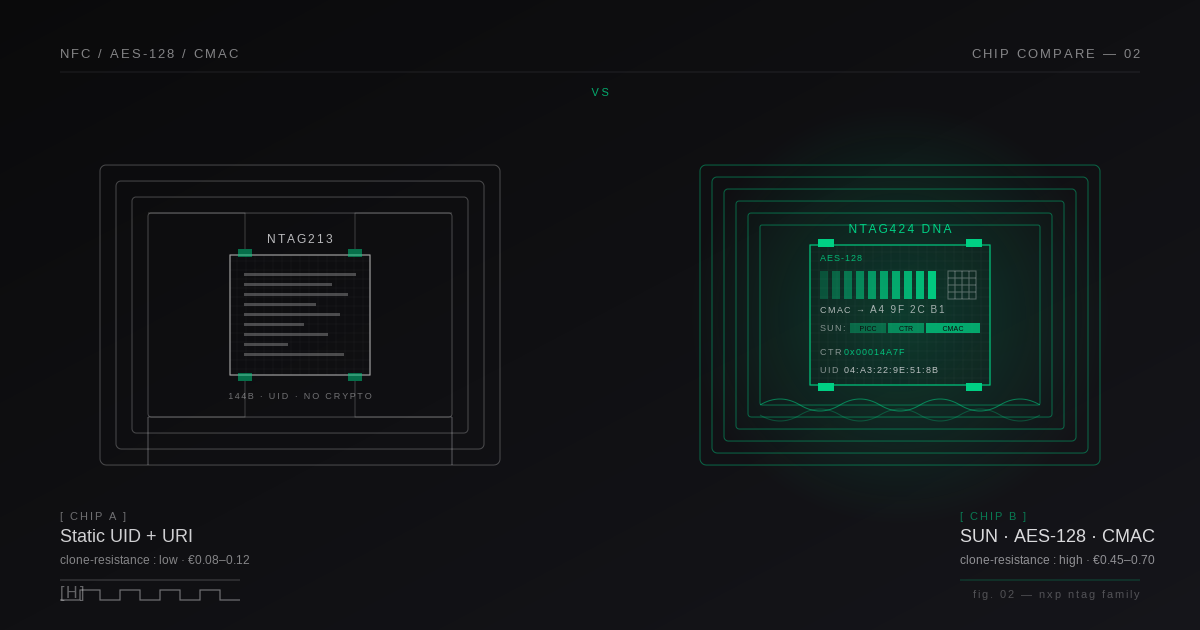
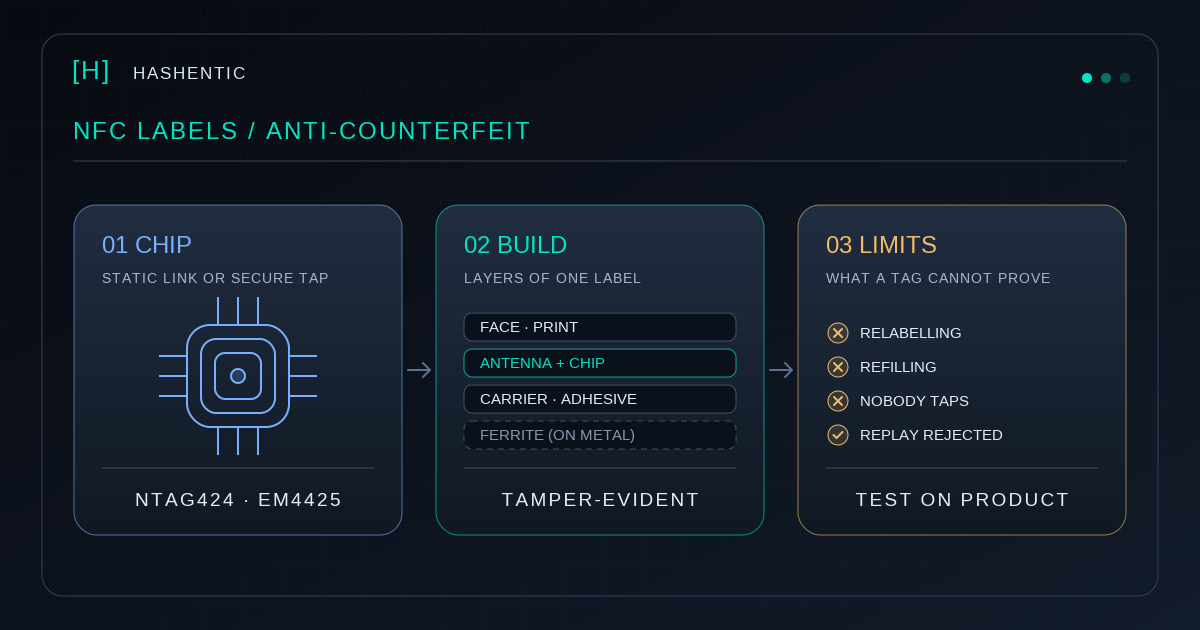
NTAG213, NTAG215 and NTAG216 return the same stored data on every read. A static URL, even one that contains the chip's UID, can be read with any phone and written to another tag, or served by a device that emulates a tag. The page behind the URL cannot tell the original from the copy.
The NFC counter mirror does not change this: the counter increases, but it is not cryptographically signed, so a copy can show plausible values. The 32-byte originality signature proves that an NXP chip with that UID exists, but a browser opening a URL never sees it, and the signature itself is static and can be replayed.
That is why Hashentic treats NTAG215 as a product link: the page looks up the identifier and opens the product record, but the result does not claim the physical item was authenticated. When Hashentic writes an NTAG215, the link ends with the chip's UID, inserted by the chip's UID mirror, so that each tag points to its own record.
When to step up to NTAG424 DNA or EM4425
Move to a secure chip when a copied tag would cause real harm: counterfeit-prone goods, high-value items, returns fraud or grey-market diversion. NTAG424 DNA generates a new AES-128-based message (SUN/SDM) on every tap, which the server checks together with a read counter; EM4425 uses its own cryptographic response and Security Token. A copied URL from either chip fails verification once it has been used.
| Need | NTAG213 / 215 / 216 | NTAG424 DNA / EM4425 |
|---|---|---|
| Open a product page, manual or offer | Yes | Yes |
| Stop casual overwriting | 32-bit password or lock | Keys and access rights |
| Detect a copied or replayed tag | No | Yes, checked by the server |
| Supported in Hashentic | NTAG215 for product links | Both, for secure verification |
Swipe or scroll horizontally to compare columns.
The comparison of NTAG213 and NTAG424 DNA is covered in depth in our earlier article, and the technology page summarises what Hashentic supports. If you are planning a pilot, start with the NFC pilot checklist or ask us for a demo.
FAQ
Is NTAG215 better than NTAG213?
NTAG215 is not more secure; it has more memory (504 bytes instead of 144). Choose it when the URL or data does not fit on an NTAG213 or when you want spare capacity.
Can an Android phone or iPhone write NTAG213, NTAG215 and NTAG216?
Yes. Android phones with NFC and iPhones that support Core NFC tag writing (iOS 13 and later) can write NDEF data to all three chips with a suitable app.
Can someone copy an NTAG215 tag?
The URL and other stored data can be read and written to another tag. A write password prevents overwriting, not copying. Use NTAG424 DNA or EM4425 when copies must be detected.
Can I unlock a locked NTAG tag?
No. The lock bits are one-time programmable. A password can be changed if you know it, but a locked memory area stays read-only.
Which NTAG chips does Hashentic support?
NTAG215 for product links, and NTAG424 DNA and EM4425 for secure verification. NTAG213 and NTAG216 are not in Hashentic's supported list.