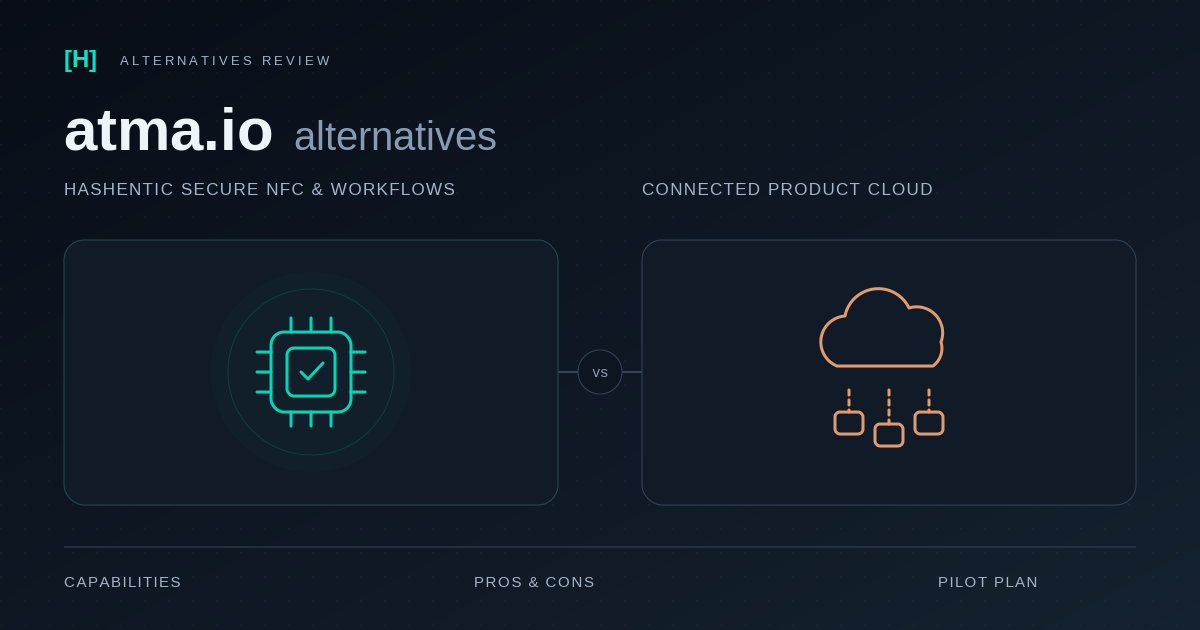
atma.io is Avery Dennison's connected product cloud. It gives physical items digital IDs and records their events from source to consumer, with modules for traceability, inventory, sustainability, consumer interaction, product authentication and digital product passports. If you are comparing atma.io alternatives, be clear about scope: an enterprise supply-chain programme and a focused authentication project are different purchases.
Reviewed on 20 November 2026. Written by Hashentic, one of the providers compared. The table distinguishes our implemented capabilities from the provider descriptions on the official atma.io and Avery Dennison pages linked below. “Confirm” means the reviewed sources do not establish the exact feature; it is not a claim that the feature is absent. Recommendations are our assessment of fit, without comparative security testing or equivalent commercial quotes.
The decision behind the comparison
atma.io is built around item-level events across the supply chain: chain of custody, inventory accuracy, expiry dates, sensor monitoring and circularity programmes. Avery Dennison also sells it as part of a bundled DPP service with consultancy, hardware, software, digital ID technology, physical labels and support. Its first DPP-as-a-Service customer, Burton, already used Avery Dennison RFID and planned interactive QR codes for digital care labels.
Hashentic is narrower. It verifies secure NFC tags (NTAG 424 DNA or EM4425) on the product, shows a configured product page and passes the result to forms and workflows. It does not run inventory, logistics or store operations.
So start with the problem. If you need RFID-driven inventory and supply-chain visibility across millions of items, compare enterprise traceability platforms. If you need a customer, inspector or returns team to check a product with a phone tap, compare how each option proves the physical item is genuine.
Capabilities at a glance
| Capability | Hashentic | atma.io |
|---|---|---|
| Authentication evidence | NTAG 424 DNA and EM4425 cryptographic checks; static QR/NTAG215 are information links. | Product authentication module along the product journey; confirm the data carrier and verification method. |
| Data carrier | NFC tags written by the brand's team; QR as an information link. | Digital IDs from Avery Dennison, including RFID and QR in the Burton DPP case; confirm secure NFC. |
| Product passports | Configurable records and public JSON-LD data; required content must be verified. | DPP Portal to create passports and data carriers; also sold as the bundled ReadyDPP service. |
| Supply chain | Not offered beyond scan records. | Traceability, inventory accuracy, anti-grey-market, expiry dates and sensor monitoring. |
| Customer experience | Branded pages with templates selected by country, identifier type and labels. | Consumer interaction module for targeted, context-dependent experiences. |
| Forms and automation | Forms, eight triggers, ten action types and conditions; optional AI-assisted drafts. | Confirm post-scan forms and workflow configuration. |
| Integration and setup | REST API, incoming webhooks, outgoing HTTP actions; tags written with the iPhone/Android app or the desktop utility. | Confirm API and integration scope. |
Swipe or scroll horizontally to compare columns.
Sources: atma.io solutions; atma.io digital product passport; Avery Dennison DPP-as-a-Service announcement, 31 October 2023.
Hashentic: product authentication, digital product passport, forms, workflows and platform.
Pros and cons
Hashentic
Strengths
- Named secure chips and a verification check on every tap.
- A pilot can start with your own phones or a USB reader writing the tags.
Limitations and trade-offs
- No inventory, logistics or RFID store operations.
- DPP content requirements must be verified for your product category.
atma.io
Strengths
- Item-level events across supply chain, stores and circularity in one cloud.
- Labels, hardware, software and consultancy available from one supplier.
Limitations and trade-offs
- The reviewed pages do not explain how product authentication is verified.
- Enterprise scope; no published prices for a small authentication pilot.
A pilot that answers the important questions
- Tag one product line and test the customer tap or scan on the phone models your market uses.
- Copy a label or URL and check what the scan of the copy shows.
- Decide which events you really need: production, shipping, store, resale or return.
- Check who owns the tag data and how you export it if you change provider.
- Compare the full cost: tags or labels, encoding, attachment, software and support.
When to choose which
Choose Hashentic when the project is about proving that an individual product is genuine with a phone tap, followed by configured pages, forms and actions, and you want to start with a contained pilot.
Include atma.io when you already use Avery Dennison labels or RFID, need item-level supply-chain and inventory data across many sites, or want a bundled DPP service with labels and consultancy.
Neither recommendation is a security ranking. A tap-level NFC check and a supply-chain event history answer different questions, and some programmes need both.
Discuss your pilot with sample products and an agreed test plan.
Related guides
- Product authentication platforms compared
- Digital product passport data model
- NFC vs QR for product authentication
- NFC product authentication pilot checklist
Frequently asked questions
Who owns atma.io?
atma.io is Avery Dennison's connected product cloud. Avery Dennison describes it as part of its digital solutions portfolio and uses it for its DPP-as-a-Service and ReadyDPP offers.
Is Hashentic a full replacement for atma.io?
Only for the authentication part. Hashentic verifies secure NFC tags and manages the product page and follow-up actions. It does not provide inventory management, logistics tracking or RFID store operations.
Does atma.io use NFC?
The reviewed atma.io pages do not name NFC. The Burton DPP announcement mentions RFID and interactive QR codes. Ask Avery Dennison which carrier and verification method they propose for your product.
What do I need to start a Hashentic pilot?
Secure NFC tags (NTAG 424 DNA or EM4425), an NFC-capable iPhone or Android phone with the Hashentic app or a USB reader with the desktop utility, and product data for the verification page.