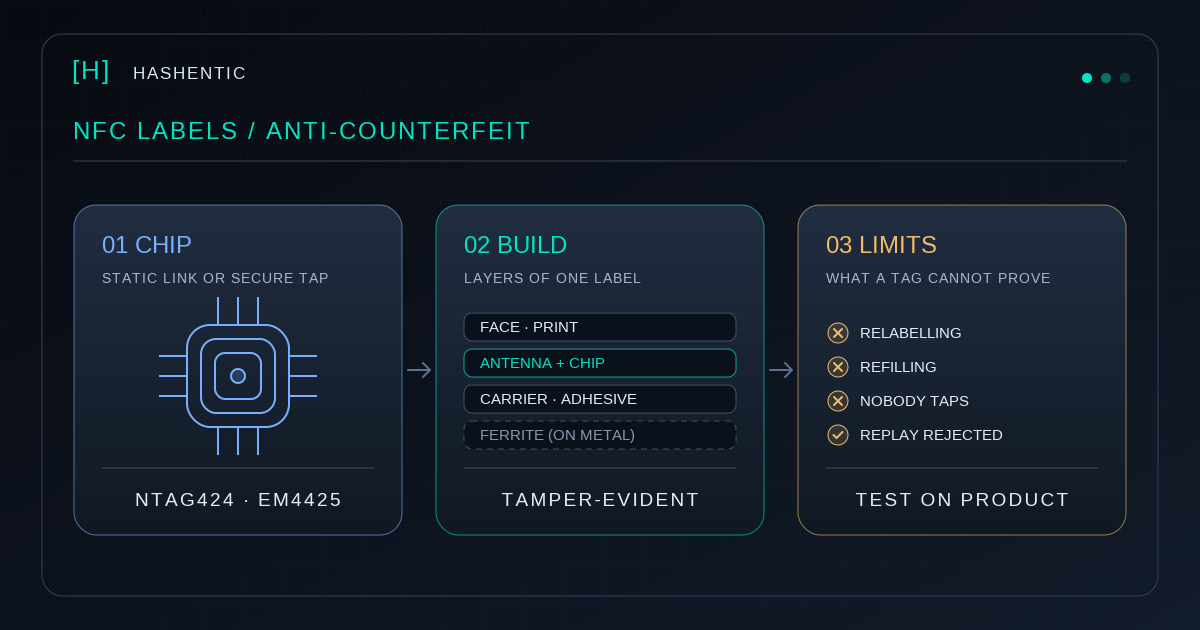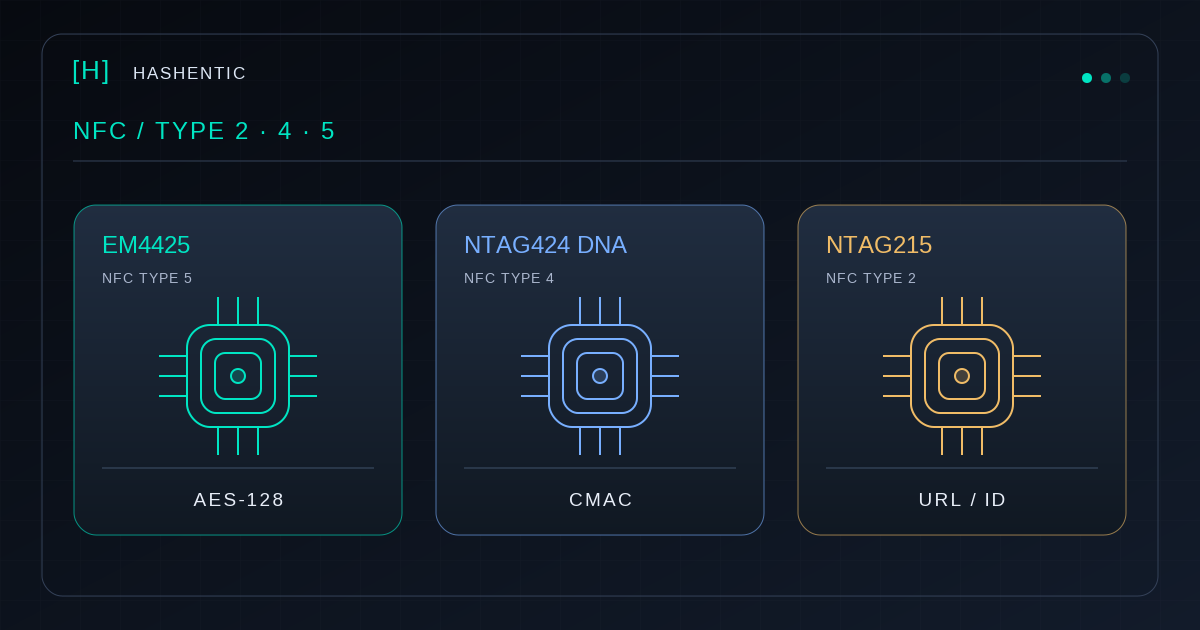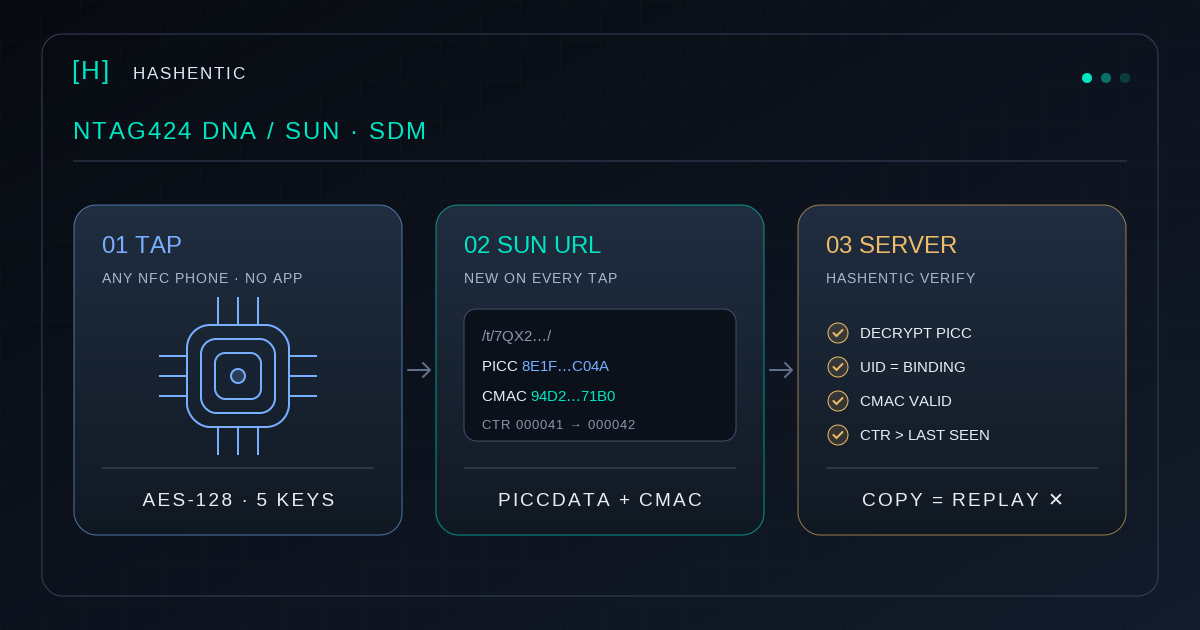
NTAG424 DNA is an NFC chip from NXP that does something an ordinary NFC sticker cannot: every time a phone reads it, the chip produces a new URL containing an encrypted read counter and a cryptographic signature. A server holding the right key can check that signature and tell a genuine tap from a copied link. NXP calls this feature Secure Unique NFC (SUN).
This article explains how that works, from the chip's keys to the server's decision. If you are still choosing between a simple product link and a secure chip, start with our comparison NTAG213 vs NTAG424 DNA; here we assume NTAG424 DNA is on the table and look inside it.
Figures from the NTAG 424 DNA datasheet and the NXP product page.
What is NTAG424 DNA?
NTAG424 DNA (part number NT4H2421Gx) is an NFC Forum Type 4 tag that communicates over ISO/IEC 14443-A, the same interface phones use for contactless payments. Its 416 bytes of memory are organised as an ISO/IEC 7816-4 file system with a 256-byte NDEF file, the file a phone reads when you tap the tag.
What sets it apart is the security layer. The chip holds five AES-128 keys. They leave the factory set to all zeros, and NXP recommends changing all five during personalization, even the ones an application does not use. Changing a key requires authenticating with key 0, and there is no command that reads a key back out. NXP states Common Criteria EAL4 certification for both the hardware and the software.
SUN and SDM: two names for one mechanism
The two acronyms are often used interchangeably, but they describe different levels:
- SDM (Secure Dynamic Messaging) is the chip configuration. It tells the chip which parts of the NDEF file to fill in on each read: encrypted data, a counter, a signature.
- SUN (Secure Unique NFC) is NXP's name for the result: a message that is unique to each tap and can be authenticated.
When SDM is enabled, the chip does three things on every unauthenticated read:
- Increments the read counter. The SDMReadCtr is a 24-bit value, reset to zero when SDM is switched on.
- Encrypts PICCData. The chip's 7-byte UID and the current counter are encrypted with AES, so the URL does not expose the serial number in clear text.
- Calculates an SDMMAC. An AES-CMAC (NIST SP 800-38B), truncated to 8 bytes, signs the message with a session key derived from the tag key, the UID and the counter.
The phone does not take part in the cryptography. It reads an NDEF record as it would from any tag and opens the URL. All the work happens inside the chip and on the server.
Anatomy of a SUN URL
Each tap produces the same address with different values. In Hashentic, a secure tag URL has three variable parts:
| Part | Example | What it is |
|---|---|---|
| Tag identifier | 7QX2… | Points the server to the tag's record; it does not change |
| PICCData | 8E1F…C04A | Encrypted UID and read counter, 16 bytes in hex |
| CMAC | 94D2…71B0 | 8-byte signature over the tap, in hex |
Swipe or scroll horizontally to compare columns.
Read the same tag twice and the identifier stays the same while PICCData and the CMAC change completely. That is what "dynamic" means here: a URL copied from yesterday's tap is not the URL the tag produces today. Other implementations put the same values into query parameters; NXP's application note AN12196 shows how the mirroring offsets are configured.
How the server verifies a tap
Verification is real-time: the check runs when the page opens, before the result is shown. Hashentic's backend performs these steps for every NTAG424 DNA tap:
- Find the tag record from the identifier in the URL and confirm the product is active and not blocked.
- Decrypt PICCData with that tag's AES key. If decryption fails or the UID inside does not match the registered tag, the check fails.
- Recompute the CMAC. The server derives the session MAC key from the tag key, the UID and the counter, calculates the CMAC itself and compares it with the one in the URL. A single wrong bit fails the check.
- Compare the counter with the last accepted value. A lower counter is rejected as a decrement; the same counter is rejected as already verified. Only a higher counter is accepted.
- Store the new counter and record the verification, then display the product page. The counter update is conditional, so two simultaneous requests with the same data cannot both be accepted.
Every accepted check is recorded with its time, which gives the brand a history of scans for each item. Failed checks are recorded too, so repeated attempts with stale links are visible rather than silent.
Why a copy or clone fails
Consider what a counterfeiter can actually copy.
The URL. Anyone can read the NDEF file and save the link, or photograph it from a browser address bar. But that link carries one specific counter value. Once that value has been accepted, opening the link again returns "already verified". A copied URL written onto a cheap NTAG213 sticker shows the same stale link on every tap, so it fails from its first reuse.
The chip. To produce a new valid URL, a fake chip would need the tag's AES key. The key is not readable through the chip's commands, and changing it requires the current key. Without it, the attacker cannot calculate a CMAC the server will accept.
The key on another tag. With Hashentic, each tag gets its own randomly generated AES-128 key. Learning one key would not help forge a different tag.
SUN proves that a configured chip produced the current message. It does not prove that the chip is still on the original product. A genuine tag peeled off and stuck onto a fake still verifies, so label construction and placement matter. A link captured from a tap and never opened can also be used once, until the next genuine tap advances the counter past it.
NTAG424 DNA TT: the tamper variant
NXP also makes NTAG 424 DNA TagTamper (NT4H2421Tx). It adds a tamper loop, a conductive trace across a seal or cap, with what NXP describes as once-opened and current-status detection. A closure can then show whether it has been opened as well as whether the tag is genuine.
The tamper loop is only as good as the inlay and the way it is applied to the package. Hashentic's current NTAG424 DNA check validates the CMAC and the counter; it does not evaluate tamper-loop status. If your project needs a "seal broken" result, treat it as a separate requirement and test it with your packaging. Our chip comparison covers the same point from the selection side.
What a phone needs
To read an NTAG424 DNA tag, a customer needs an NFC-capable phone with NFC enabled, and that is all. No app is needed for verification:
- Android phones with NFC read NDEF URL tags natively and offer to open the link.
- iPhone XS and later read NFC URL tags in the background, as described in Apple's Core NFC documentation. Older iPhones read tags only through an app or a system scanner.
The verification page opens in the browser. Test the phones and label positions that matter in your market: antenna size, metal packaging and liquids affect read range more than the chip type does.
How Hashentic uses NTAG424 DNA
NTAG424 DNA is one of the three chips Hashentic supports, alongside EM4425 and NTAG215. For NTAG424 DNA the flow is:
- Create the tag record. The server generates a random AES-128 key for the tag and stores it encrypted.
- Write the tag. Staff use the Hashentic app on iPhone or Android, or the Desktop utility on Windows or macOS with a USB NFC reader. The writer replaces the factory keys, sets the SUN URL and enables SDM. See how tag writing works and where each app fits.
- Customers tap. The phone opens the brand's verification page, the server runs the checks described above and shows the product page with the result.
The same product page design can serve NTAG424 DNA, EM4425 and NTAG215 tags, but the result keeps the distinction: an NTAG215 identifier lookup is never presented as a cryptographic check. See product authentication for the full customer flow, and the supported-chip guide for how NTAG424 DNA compares with EM4425.
Frequently asked questions
Is NTAG424 DNA impossible to clone?
No chip should be called impossible to clone. What NTAG424 DNA offers is that copying the visible data does not produce a working tag: a forger would need the AES key, which the chip does not reveal. Physical attacks on chips exist; Common Criteria EAL4 certification means NXP's design was evaluated against a defined set of them.
Does the customer need an app to verify an NTAG424 DNA tag?
No. Any phone that reads NFC URL tags opens the verification page in its browser. The Hashentic app is for staff who write and manage tags.
Can NTAG424 DNA be verified offline?
The check needs the tag's AES key. Keeping keys on the server means they never sit in an app that could be taken apart. A verifier without a connection could read the URL but could not tell a fresh tap from a copy.
Is the SUN URL secret?
No. It is designed to be seen. Its value comes from being used once: after the server accepts a counter, that URL and any older one are rejected.
What is the difference between NTAG424 DNA and NTAG213?
NTAG213 stores a fixed URL that anyone can copy; NTAG424 DNA signs a new one on every tap. The NTAG213 vs NTAG424 DNA comparison explains when each is the right choice.
Want to see secure NFC verification on your own product? Run the NFC pilot checklist and request a demo.