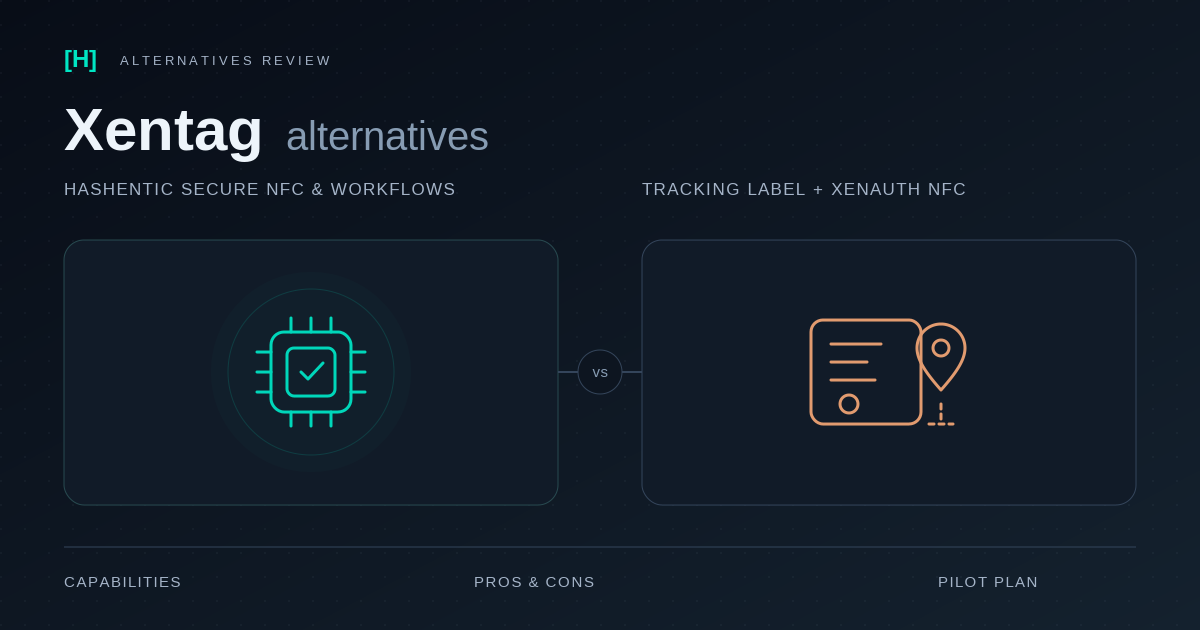
Xentag is the brand behind two products from ZenduIT: XenTag, a peel-and-stick smart label that reports shipment location, temperature and shock, and XenAuth, tap-to-verify NFC authentication for individual items. If you are looking for a Xentag alternative, first decide which of those two jobs you need to replace or complement.
Reviewed on 20 November 2026. Written by Hashentic, one of the providers compared. The table distinguishes our implemented capabilities from the provider descriptions on the official Xentag website linked below. “Confirm” means the reviewed sources do not establish the exact feature; it is not a claim that the feature is absent. Recommendations are our assessment of fit, without comparative security testing or equivalent commercial quotes.
The decision behind the comparison
Xentag presents tracking and authentication as one platform: the smart label follows the case in transit, and the XenAuth chip verifies the item after it has been unpacked. Hashentic does not track shipments. It covers the second part: verifying an NFC tag on the product, then showing a configured product page, collecting form data and triggering follow-up actions.
So the question is not which vendor “does NFC”. Ask whether live in-transit visibility is part of the requirement. If it is, an item-level authentication platform alone will not replace it. If the main goal is a customer or inspector checking a product at the shelf, at resale or at a returns desk, compare the verification itself and what happens after the tap.
Capabilities at a glance
| Capability | Hashentic | Xentag (XenTag and XenAuth) |
|---|---|---|
| Authentication evidence | NTAG 424 DNA and EM4425 cryptographic checks; static QR/NTAG215 are information links. | XenAuth chip returns a cryptographic response; confirm the chip model and how repeated messages are handled. |
| Customer experience | Branded pages with templates selected by country, identifier type and labels; no app needed to verify. | Tap without an app; XenAuth site builder for pages, microsites and authentication flows. |
| Product passports | Configurable records and public JSON-LD data; required content must be verified. | Described as “DPP-ready”: NFC for the tap, GS1 Digital Link QR as the compliant pointer. |
| After the scan | Forms, eight triggers, ten action types and conditions; optional AI-assisted drafts; owner registration and ownership transfer. | Resale, returns, warranty and ownership scenarios; confirm configurable workflows. |
| Shipment tracking | Not offered. | BLE + LTE-M label with location, temperature and shock logging. |
| Integration and setup | REST API, incoming webhooks, outgoing HTTP actions; tags written with the iPhone/Android app or the desktop utility. | REST, webhooks and OAuth 2.0 named for label events; confirm the XenAuth API scope. |
Swipe or scroll horizontally to compare columns.
Sources: Xentag website (product descriptions, FAQ and pricing for the tracking label); case studies: Marcozo, Cultish, Johnny's Kicks x Jae Tips.
Hashentic: technology, product authentication, forms, workflows and mobile app.
Pros and cons
Hashentic
Strengths
- Named secure chips (NTAG 424 DNA, EM4425) and a verification page your team configures.
- Scan results can feed forms, records and follow-up actions in the same platform.
Limitations and trade-offs
- No in-transit tracking, temperature or shock logging.
- No resale-royalty journey; owner registration and transfer need NTAG 424 DNA or EM4425 tags.
Xentag
Strengths
- One vendor for shipment tracking and item-level NFC verification.
- Published starter price for the tracking label: USD 10 per label plus USD 3 per month per asset.
Limitations and trade-offs
- The reviewed pages do not name the XenAuth chip or document its verification protocol.
- Pricing for XenAuth tags and the authentication platform is not published.
A pilot that answers the important questions
- Attach tags to the finished product and test first and repeated taps on the phone models your customers use.
- Copy the URL from a tap and open it again: the result should not look like a fresh, genuine scan.
- Run the resale, returns or warranty scenario you actually need, including what your team sees afterwards.
- If tracking matters, test the label and the authentication tag on the same shipment and check that both records refer to the same item.
- Ask who writes and provisions the tags, at which production step, and what happens to a damaged tag.
When to choose which
Choose Hashentic when item-level verification is the goal, you want to choose between NTAG 424 DNA and EM4425, write tags with your own phones or a USB reader, and turn each scan into configured forms and actions.
Include Xentag when live shipment location and condition data are part of the same project, or when you want one supplier for the tracking label and the authentication tag.
Neither recommendation is a security ranking. Compare final unit costs including chips, provisioning, attachment and support.
Discuss your pilot with sample products and an agreed test plan.
Related guides
- Product authentication platforms compared
- NFC vs QR for product authentication
- EM4425, NTAG424 DNA and NTAG215: supported chips
- NFC product authentication pilot checklist
Frequently asked questions
What is Xentag?
Xentag is a product brand of ZenduIT. It covers XenTag smart tracking labels for shipments and XenAuth NFC authentication for individual products.
Is Hashentic a direct replacement for XenTag tracking labels?
No. Hashentic verifies NFC tags on products and manages what happens after the scan. It does not report shipment location, temperature or shock. If you need those, keep a tracking solution and compare only the authentication part.
Do customers need an app to verify a product?
Not with either provider, according to the reviewed sources. With Hashentic, a phone that reads NFC opens the verification page in its browser; the Hashentic app is for staff who write and manage tags.
Which NFC chips does Hashentic support?
NTAG 424 DNA and EM4425 for cryptographic verification, and NTAG215 for product information links. The supported-chip guide explains the differences.